
His Father and Ours
We probably all have a story of accidentally leaving a child behind somewhere. Maybe you arrived home from church with one less child. I once knew a guy who left his wife behind at a rest stop. Accidentally.
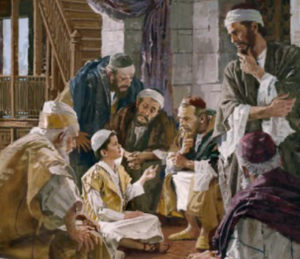
When twelve-year-old Jesus was left behind at the temple, we can imagine the words exchanged between Mary and Joseph: “I thought you knew where he was.” “I thought you went to get him.” Their level of trust must have been high, traveling with family and friends, to go a whole day without asking, “Where is Jesus?” It gives the scene a humorous, small-town feel.
Jesus was left behind, but he also stayed behind.
For most people, the experience of entering Jerusalem and seeing the temple could be described as follows:
At one glance, [they] would see before [them] the whole city—its valleys and hills, its walls and towers, its palaces and streets, and its magnificent Temple—almost like a vision from another world.1
But for the boy, conceived by God’s intervention in the virgin’s womb, it was that and more. We can imagine his first journey to Jerusalem; as he made the last turn in the road, his longing for a view of the city almost made his heart burst. After three days of absence, Jesus said to his parents, casually, “Did you not know that I must be in my Father’s house?” (Luke 2:49b ESV) To Jesus, there was a filial love for the temple rivaling that of his natural family. Years later, when this same temple had become a marketplace for profiteers, he was consumed with zeal for his Father’s house and moved to passionate action. There was a difference between Jesus’ relationship to the temple and that of everyone else.
In the temple, the teachers were amazed by Jesus’ questions and answers. Jesus’ parents were astonished by everything they saw. And Jesus, in response, was puzzled, “Why were you looking for me?” (Luke 2:49a). They didn’t understand Jesus, though Mary treasured these things in her heart. When, at a later time, upon returning home, she unpacked the baggage of her memories, she may have realized that Jesus’ loyalty to his parents was shifting gradually toward his Father in heaven.
The years passed. Jesus’ affinity with his natural family is brought into contrast with his relationship to those who believed in him, his friends.
And his mother and his brothers came, and standing outside they sent to him and called him. And a crowd was sitting around him, and they said to him, “Your mother and your brothers are outside, seeking you.” And he answered them, “Who are my mother and my brothers?” And looking about at those who sat around him, he said, “Here are my mother and my brothers! For whoever does the will of God, he is my brother and sister and mother.” (Mark 3:31-35 ESV)
This was a casual gathering. Those sitting around felt the liberty to interrupt: “Hey, Jesus, your mother and your brothers are outside…” Jesus, Emmanuel, delighted to be with his friends—yet they were more than friends; they were his brothers and sisters.
In Jesus’ three days in the temple as a boy, sitting among the teachers in the presence of his Father, we catch an early glimpse of his growing loyalty to his larger family. Because the Father in heaven is Jesus’ Father, and because of what Jesus accomplished through his death, his Father is now also our Father, and Jesus our elder brother. He delights to be with us, and we with him, and with all our brothers and sisters.
1 Alfred Edersheim, The Temple: Its Ministry and Services as They Were at the Time of Jesus Christ, Chapter 1, “A First View of Jerusalem and of the Temple,” accessed via Swartzentrover.com (edition of the public-domain text).
